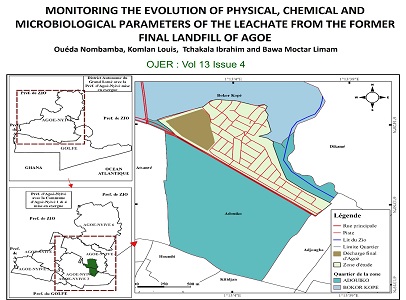
MONITORING THE EVOLUTION OF PHYSICAL, CHEMICAL AND MICROBIOLOGICAL PARAMETERS OF THE LEACHATE FROM THE FORMER FINAL LANDFILL OF AGOE
High Institute of Sustainable Development, Yembila Abdoulaye Toguyeni University, BP 54, Fada N’Gourma, Burkina Faso
Landfills release leachate, a highly polluting effluent resulting from the percolation of rainwater through waste. The infiltration of this leachate into the subsoil compromises groundwater quality and public health. To assess the level of groundwater contamination two years after the rehabilitation of the former Agoè-Nyivé landfill in Togo, a survey of local residents and physicochemical and bacteriological analyses of the leachate were conducted. Bacteriological and physicochemical analyses were carried out according to the standards of the French Standards Association on samples of collected leachate. The survey found that more than 76% of respondents said they had seen the leachate and believed it had an environmental impact. The leachate had a high pollutant load, with a conductivity of 33660 μS/cm, a high ammonium concentration of 951 mg/l, a BOD₅ of 22 mg/l. The oxidizability (2650 mgO2/L) is relatively high in the leachate, indicating strong organic degradation activity. However, the ETMs sought in the samples are mostly below the detection threshold. Bacteriological analyses showed that the leachate was contaminated with all the germs tested. Furthermore, mesophilic aerobic germs are present at a very high level of 76,000 CFU/mL. These results demonstrate that the groundwater near this former landfill could be polluted, highlighting the importance of post-closure monitoring for resource preservation.