INDIA’S CLIMATE LEAP OR LAG? A TECHNICAL REVIEW OF THE 2035 NDC FRAMEWORK
Chaitanya Climate Research Inc. Surat, 395017, Gujarat India
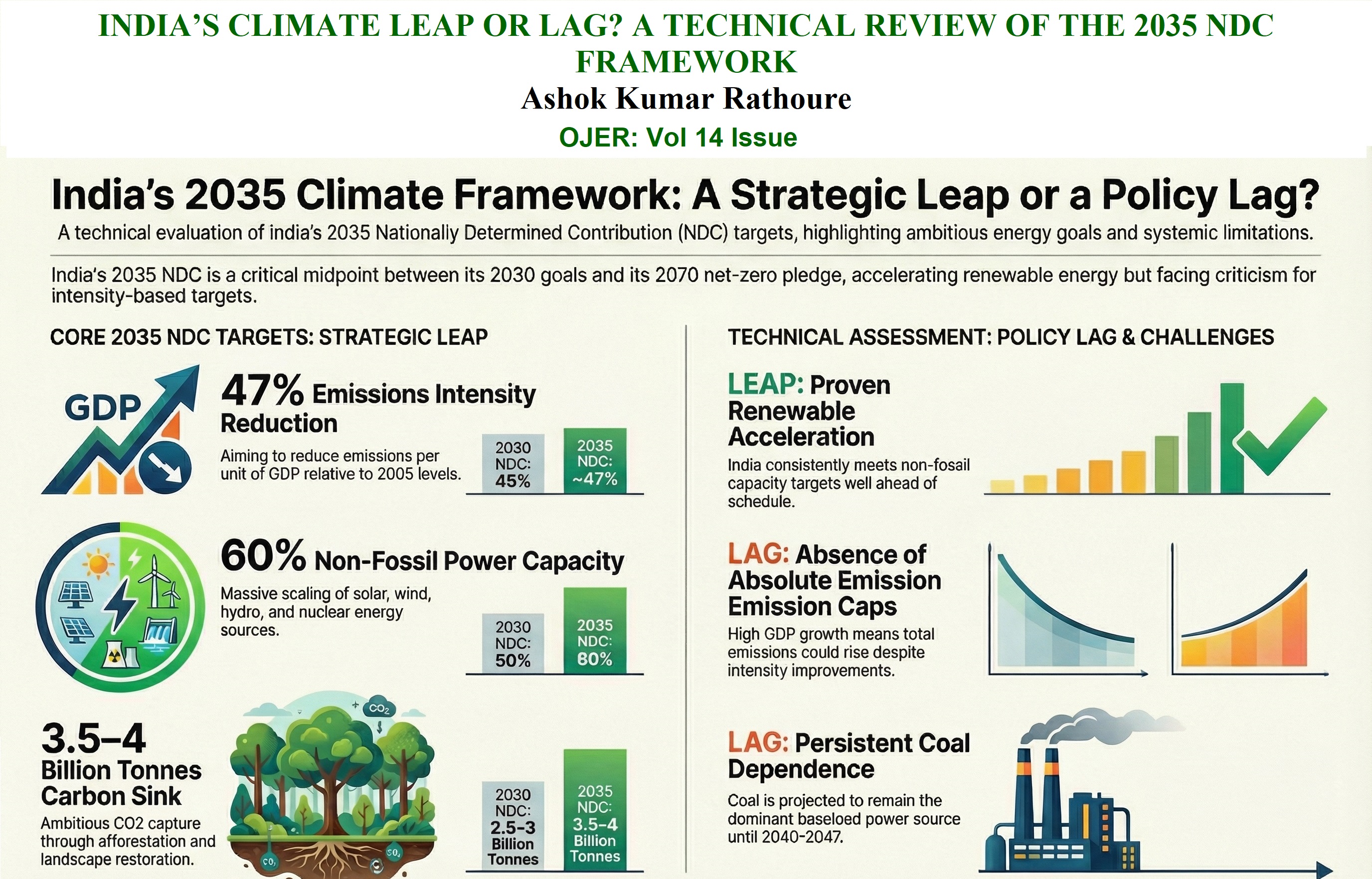
India, the world’s third-largest greenhouse gas emitter and one of the fastest-growing major economies, occupies a pivotal position in global climate efforts. Following its enhanced 2030 commitments, the 2070 net-zero pledge, and the March 2026 approval of its 2035 Nationally Determined Contribution (NDC) framework, India has established a critical midpoint in its long-term decarbonization pathway. This technical review critically evaluates whether the 2035 NDC represents a transformative leap or a measured progression. The framework is anchored by four pillars: a 47% reduction in emissions intensity from 2005 levels, 60% non-fossil installed power capacity, an enhanced carbon sink of 3.5–4 billion tonnes of CO₂ equivalent, and sectoral transformation through initiatives like the Green Hydrogen Mission. The analysis reveals a mixed picture. India has demonstrated remarkable progress, achieving its 2030 non-fossil capacity target ahead of schedule and ensuring policy continuity that bolsters investor confidence—indicative of a partial climate leap. However, significant limitations persist: continued reliance on intensity-based rather than absolute emission targets, absence of a concrete coal phase-down roadmap, lack of binding sectoral targets for hard-to-abate industries, and uncertainty surrounding the ambitious carbon sink goal. Implementation challenges are formidable, including an estimated $10–22 trillion financing requirement by 2070, critical technological gaps, weak monitoring systems, and the imperative of a just transition for coal-dependent communities. While India’s approach is grounded in Common but Differentiated Responsibilities, global 1.5°C pathways suggest that even major developing economies may need to peak absolute emissions between 2030 and 2035—a milestone the current framework does not guarantee. The review concludes that the 2035 NDC represents a strategic progression rather than a full transformation. The period between now and 2035 constitutes the decisive decade, determining whether India can transition from incremental action to the systemic decarbonization required to meet its 2070 net-zero ambition.