HYBRID GOVERNANCE AND ENVIRONMENTAL SUSTAINABILITY: AFRICAN PERSPECTIVES BASED ON THE CASE OF BOBO-DIOULASSO
Agora International American University, Lewis, Delaware 19958, USA
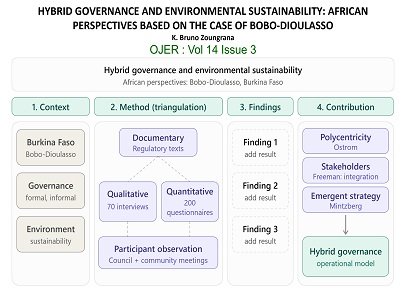
Environmental governance in African cities remains under-researched regarding the coexistence of municipal and customary authorities—a relationship often perceived as conflict-ridden. This study addresses this gap by analyzing how this institutional dualism can be transformed into a strategic resource for territorial sustainability, using the case of Bobo-Dioulasso (Burkina Faso). The methodology employs a triangulation of documentary, qualitative, and quantitative approaches, combining the analysis of regulatory texts, interviews with 70 institutional and community stakeholders, questionnaires administered to 200 citizens, and participant observation during municipal council sessions and community meetings. fThe results demonstrate that hybrid governance can serve as a framework for territorial resilience, provided that roles are clarified, financial autonomy is strengthened, and indigenous knowledge is institutionalized. The article’s distinctive contribution lies in highlighting institutional fragmentation as a strategic resource by integrating concepts of polycentricity (Ostrom), stakeholder integration (Freeman), and emergent strategy (Mintzberg). This operational model of hybrid governance offers insights for environmental policies tailored to African realities.