CONSTRAINTS RELATED TO SESAME CULTIVATION IN THE SUDANIAN ZONE OF BURKINA FASO: THE CASE OF THE MANGODARA AREA
Nazi Boni University, Institute of Rural Development 01 BP. 1091 Bobo-Dioulasso 01 Burkina Faso Burkina Faso
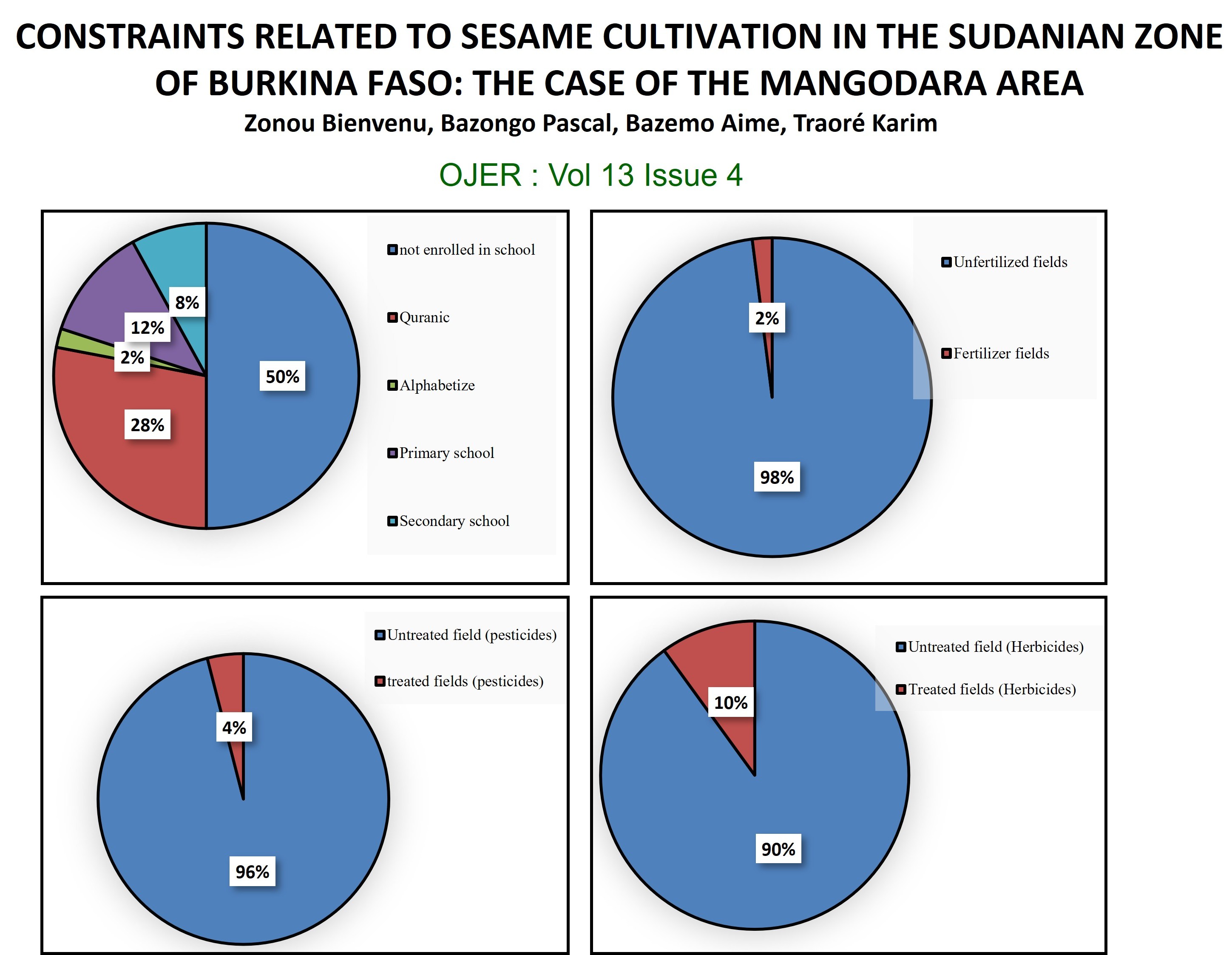
In the search for diversification of income sources, producers have adopted sweet potato cultivation in their crop rotation, especially in irrigated plains. Despite the growing interest of producers in this crop, few results exist on the production systems as practiced by the producers with a view to sustaining the activity. Sesame production is an activity mainly carried out by people aged 15 to 45 in the Mangodara area with the aim of improving their living conditions. The crop generally grows better in sandy soils than in clay-sandy soils. The farmers' enthusiasm for this activity may indicate that it provides significant income. However, this crop faces challenges. The aim of this study is to analyze the constraints related to sesame cultivation in the Sudanian zone of Burkina Faso. To conduct this study, a semi-structured survey was carried out over 12 months with 75 producers. Data analysis showed that the lack of financial resources, fertilizers, pesticides, storage, and fluctuations in selling prices are the main constraints related to sesame production. The survey results indicate that 2% of producers apply fertilizers to sesame, compared to 98% who do not apply any fertilizer to their sesame fields. 10% of producers apply herbicide treatments in the fields to combat weeds, compared to 90% of producers who report not applying any treatment. This indicates that many challenges need to be addressed to overcome these various difficulties. This level of adaptation could be improved through technical training, access to quality seeds, and access to credit. The present study made it possible to understand the adaptation strategies developed by sesame producers. Further studies are needed to determine the impact of cultivation on soil properties and to consider options for ensuring its sustainability.